Friday, July 8, 2022

M&A Deal Flow Evolving


Why Senior Living M&A Is Tilting Toward a Buyers’ Market

A lower cost of capital and a shallow pool of acquisition opportunities have made conditions more favorable for sellers of senior living properties in recent years — but there are recent signs that the market is tilting back toward the buyers. 

For one, senior living operators are still grappling with a higher cost of doing business for many important line items, from food to labor. Although many senior living companies have done well treading water over the last two and a half years, owners of these assets — particularly underperforming or distressed communities — are increasingly looking to sell. At the same time, interest in senior living development is rising, meaning more companies are opting for new builds rather than seeking an acquisition target.

All of that is helping to make conditions more favorable for buyers of properties by driving down pricing for existing assets. In recent weeks, several operators have shared with SHN that they are seeing more good deals on the market today than only months prior.

ADVERTISEMENT

While the vast majority of deals coming to market now were pre-baked months ago, a more recent combination of higher interest rates, inflation and pressure on operators to bring more capital to the table have caused deal activity to sputter, according to National Investment Center for Seniors Housing and Care (NIC) Chief Economist Beth Mace. 

“The markets have changed largely because of what’s going on in the economy, and largely because of the threat of rising inflation,” Mace told Senior Housing News.

Landscape ‘still evolving’ 

Mace cautioned that the financial landscape for senior living buyers and sellers is “still evolving,” and that there is “a little bit of discovery left to be done” with regard to finding where industry pricing and valuations will ultimately land.

ADVERTISEMENT

While it’s clear the market fundamentals are changing, some in the industry see this as a continuation of an older trend. For instance, JLL Capital Markets Managing Director Cody Tremper said he believes the industry has been in a pricing discovery phase since the start of the pandemic, and that interest rate hikes are not the cause of recent market shifts.

“It’s been a challenging time for the industry throughout Covid,” he told SHN. “I don’t think the interest rates moving has necessarily swung [the market] in favor of buyers all of a sudden.”

He added that JLL is still seeing robust deal volume and a range of opportunities to access capital.

But what has perhaps changed is the widening gap between companies that are well-capitalized, and those that are not. Specifically, buyers lacking a strong capital position face far more risk exposure and potentially require negotiations from a seller to complete a transaction, whether it’s a seller note or a concession on price, said White Oak Healthcare Partners Managing Director Jason Dopoulos. 

Buyers and sellers are also working more closely together to find solutions and close deals e, said Senior Living Investment Brokerage Managing Director Ryan Saul. 

While the senior living asset class remains a strong performing asset class, a buyer will likely need to come up with more capital to get deals done in today’s climate, he added. Inversely, sellers might not be able to pull out as much equity on a sale or a refinancing to get over the finish line.

ADVERTISEMENT

Although Saul said he believed the industry was still in a sellers’ market for quality, high-performing assets he sees more downward pressure on valuations and pricing for distressed assets.

“It’s starting to normalize,” he said. It’s heavily been a seller’s market but we are starting to see more balance.”

A recent CBRE survey showed average cap rates in senior housing have compressed since last year. The average senior housing capitalization rate fell by 2 basis points from pre-pandemic levels in 2020, which CBRE noted indicates slightly higher asset values.

That is a trend that VIUM Capital Executive Managing Director Kassem Matt has also noted.

But while the goal posts for getting a deal done could be moving closer together, Tremper highlighted the fact that cap rates within senior living never got as low as some other real estate asset classes, particularly those that saw a massive run-up in value due to lower borrowing costs prior to the Fed’s actions. 

“We still see a broad range of different product types available out there, from stabilized products to devalued products and all the way down,” he said. 

Even with capital circulating still in the market, prices could be trending down, Matt added. 

Buyers willing to take on more risk in the form of distressed assets “have a little more power than they had pre-Covid,” Dopoulos said. 

“But when you flip sides, the owners aren’t going to make concessions for what’s going on right now in terms of the difficulty others may be having in their local market,” he added ” 

In the meantime, interest rates are potentially set to rise again, with Fed officials signaling a rate hike would be “reasonable” for later this month. The looming hikes could put pressure on sellers to rid underperforming properties — also to the advantage of buyers.

At the end of the day, those who are well-capitalized can work out deal financing and snap up turnaround properties as value-adds to their portfolio. That’s seen in excitement from White Oak’s clients, Dopoulos said, as they are able to get turnaround properties at a good price. 

Looking ahead

With the Fed laser-focused on tamping down rising inflation, transactions might pick up in the short-term as stakeholders scramble to lock in deals. But in the long-term, Mace predicted that higher interest rates could eventually dampen M&A activity.

“That would probably be through this year and into next year,” Mace said. 

Tremper said those well-positioned within senior living will continue to make deals regardless of market conditions. Operator demand for value-add projects for operators is also running high. 

“Over the next five years, [senior living] is a great place to be and I think macro-wise, a lot of smart capital understands that,” Tremper said. 

Although the massive wave of distressed assets predicted at the start of the pandemic has yet to materialize, , Saul said he felt owners were still “trying to hold on,” before selling and ride out bad conditions — but they can only kick the can so far down the road.

“There are going to be more opportunities in tertiary markets, and consolidation is making the game tougher for individual private owners to make a go of it without economics of scale and buying power,” he said.

For White Oak, Dopoulos said he expected federal and agency lending to be “a little slower than normal” for the remainder of the year, while there could be the potential for increased bridge loan lending due to an increased demand for all acquisition types. 

“I don’t see anything big happening,” he added. “No one wants crazy surprises from the Fed and absent inflation running wild we could see some stabilization going through the fall and into winter.” 

Both Kass and Kennedy said they hope lenders and investors are “realistic” about pro forma financials and headwinds from inflation, interest rates and inflation. For buyers the challenge is buying properties at an appropriate basis to not incur vast risk. 

“If you look at the shape of the yield curve, continued flattening of the curve says you want to get into the permanent markets as fast as you possibly can,” Kass said. “The shape of the curve is going to be critically important as those decisions are made and how we get there.”


Real Estate

Wenston DeSue is a realtor, organizational consultant, design, construct, build expert and developmental networker.  Real estate is the business of exchange and affects every person on the planet.  Real estate on all levels represents resources, access and ultimately, power.  Knowledge is power…


Wednesday, July 6, 2022

IMF’s Stark Global Prediction.


IMF's Georgieva says global economic outlook has 'darkened significantly'


Reuters reports on an interview with IMF's Georgieva who says a global recession in 2023 cannot be ruled out. 

''The head of the International Monetary Fund (IMF) on Wednesday said the outlook for the global economy had "darkened significantly" since April and she could not rule out a possible global recession next year given the elevated risks.

IMF Managing Director Kristalina Georgieva told Reuters the fund would downgrade in coming weeks its 2022 forecast for 3.6% global economic growth for the third time this year, adding that IMF economists were still finalizing the new numbers.

The IMF is expected to release its updated forecast for 2022 and 2023 in late July, after slashing its forecast by nearly a full percentage point in April. The global economy expanded by 6.1% in 2021.''

  • IMF managing director Georgieva says can't rule out possible global recession in 2023.
  • IMF's Georgieva says global economic outlook has 'darkened significantly' since last economic update in April.
  • IMF's Georgieva says IMF will downgrade previous forecast for 3.6% growth in global economy in 2022 and 2023.

Market implications

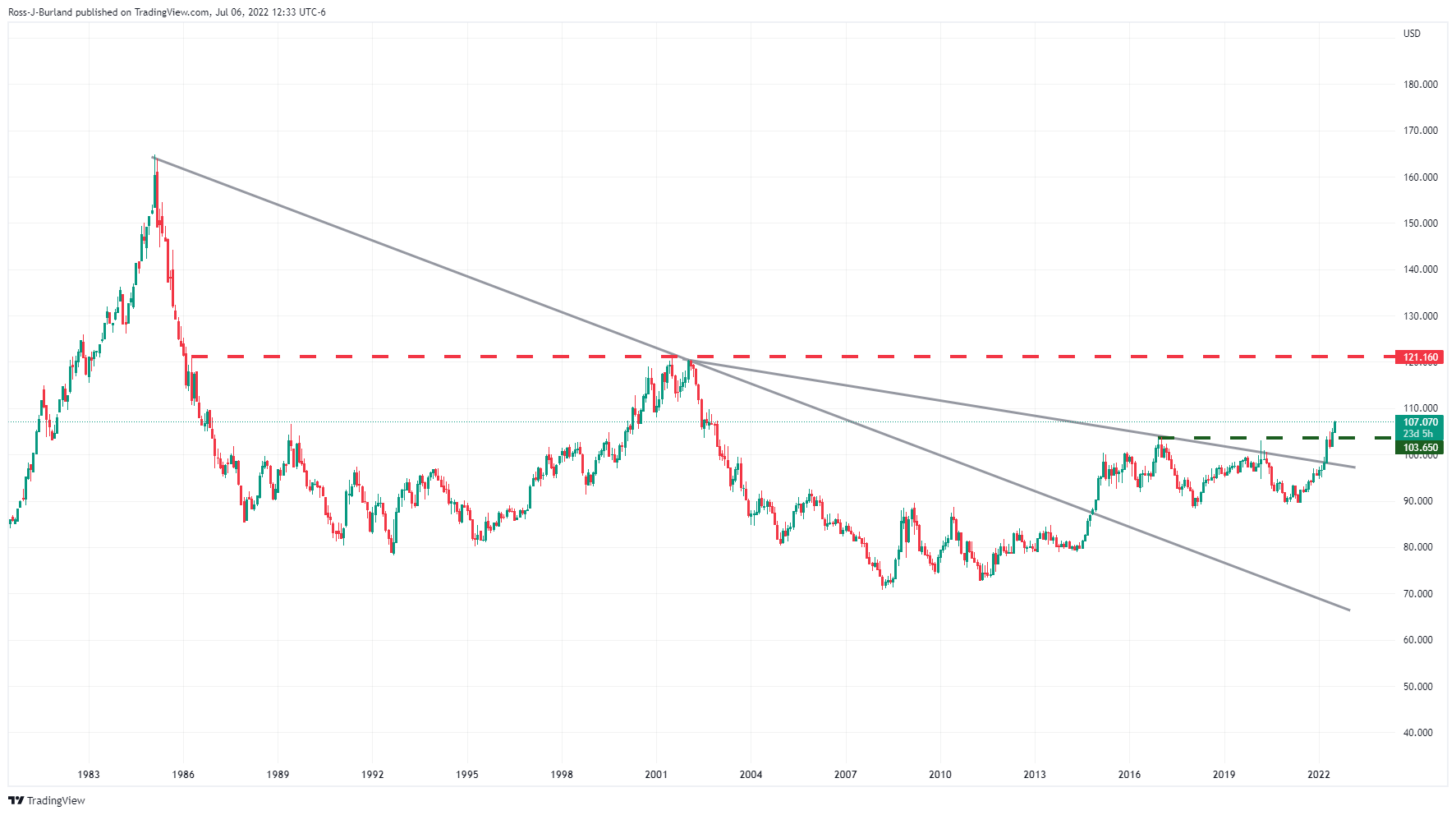
The US dollar has been in demand this week as concerns mount about the global economy. DXY, a measure of the US dollar vs a basket of rival major currencies has rallied to a fresh cycle bull high.


(DXY monthly chart)

Information on these pages contains forward-looking statements that involve risks and uncertainties. Markets and instruments profiled on this page are for informational purposes only and should not in any way 


Real Estate

Wenston DeSue is a realtor, organizational consultant, design, construct, build expert and developmental networker.  Real estate is the business of exchange and affects every person on the planet.  Real estate on all levels represents resources, access and ultimately, power.  Knowledge is power…
Tuesday, July 5, 2022

MEDICAL DEBT…OUTTA THERE!


This is MAJOR!

NEWS & MEDIA

Credit scores credit report
courtneyk / getty images

Most Credit Scores Stop Counting Medical Debt…

The three big credit reporting agencies now don’t include medical debt in reports for banks, landlords, etc.; and they won’t report small medical debts at all in 2023.

NEW YORK – Help is here for many people with medical debt on their credit reports.

Starting July 1, the three major U.S. credit reporting companies stopped counting paid medical debt on the reports that banks, potential landlords and others use to judge creditworthiness. The companies will also start giving people a year to resolve delinquent medical debt that has been sent to collections before reporting it – up from six months previously.

Next year, the companies also will stop counting unpaid medical debt under at least $500.

The companies say these moves will wipe out nearly 70% of the medical debt listed on consumer credit reports.

Patient advocates call that a huge advance. But they question whether medical debt should be on credit reports at all, given that many see it as a poor indicator of whether someone is trustworthy for a loan or rent.

“These aren’t people who bought shoes they couldn’t afford,” said Amanda Dunker, of the nonprofit Community Service Society of New York. “They went to a doctor because they were sick or needed help with an injury.”

Brooke Davis had about $1,300 in medical debt from a breast cancer scare that lingered for years on her credit report. The 48-year-old McDonough, Georgia, resident said that made it difficult to rent an apartment, and she needed a co-signer for a car loan.

“You can’t get anything, you can’t even get a credit card if you have bad credit,” she said.

The non-profit RIP Medical Debt relieved Davis’s debt last fall. But more health problems and the loss of a job have pushed Davis back into debt. She’s currently stuck with a swollen knee for which she can’t see her doctor.

“I don’t have the money to really go for my knee right now, so I’ve just been suffering with it,” she said.

The federal Consumer Financial Protection Bureau (CFPB) has said its research shows mortgages and credit cards are better predictors than medical bills of whether someone will repay a debt. The agency, which monitors banks, lenders and other financial institutions, has noted that people often don’t have time to shop for the best price when they seek care and may have little control over the progress of a serious illness.

Medical billing errors can wind up on credit reports. And patients are sometimes unsure about what they owe or whether an insurer will eventually pay it.

The agency said earlier this year it estimates that 58% of the debt in collections and on credit records is from medical bills, and past-due medical debt is more prevalent among Black and Hispanic people.

The bureau is trying to determine whether unpaid medical bills should be included on credit reports. John McNamara, an assistant director with the bureau, declined to estimate when the agency might make a decision. It could propose a rule, after hearing from all sides on the issue, that would end the practice.

Credit reporting companies also are considering whether medical debt should remain on the reports, said Justin Hakes, a vice president with the Consumer Data Industry Association. 

The three national credit reporting agencies – Experian, Equifax and TransUnion – announced the medical debt changes in March, after the bureau said it would hold those companies accountable for the accuracy of their reports.

Patient advocates said those changes will help a lot of people. The wait in reporting delinquent debt will give patients time to figure out how to resolve a bill, noted Chi Chi Wu, an attorney with the National Consumer Law Center. “It gives more breathing room to deal with the insurance company or your provider,” Wu said. “Everybody has a story about that.”

Much of the medical debt that landed on Melina Oien’s credit report several years ago was for bills that were under $500. The Tacoma, Washington, resident said she was living in an expensive place, Hawaii, where her former husband was stationed for the military. They were getting care for a daughter who had health issues that included a rare condition that affected her metabolism.

“We would zero out our checking account with living expenses every month,” she said. “When you are counting out $5 for gas until the next payday, how do you pay a $30 bill?”

A severance package from the military eventually helped them pay their medical debt a few years ago. Oien said her credit score jumped about 70 points just from that. But before that happened, they had to deal with higher interest rates on any loans they took out, and they could only get a mortgage after her sister gave them money to pay down some debt.

“It was embarrassing, it was very stressful,” said Oien, who now works as a patient advocate.

Real Estate

Wenston DeSue is a realtor, organizational consultant, design, construct, build expert and developmental networker.  Real estate is the business of exchange and affects every person on the planet.  Real estate on all levels represents resources, access and ultimately, power.  Knowledge is power…

Saturday, July 2, 2022

Tales From The Crypto…Watch That!


Crypto Meltdown Claims Rolex and Patek Philippe as Victims

Prices for the most popular secondhand luxury watches have peaked. It’s the latest sign that the bling boom might not last.

Tastemaking.
Tastemaking.

Source: Bloomberg

Updated on

The crypto meltdown has claimed its first luxury victim: the Rolex Daytona.

After reaching record highs earlier this year, prices for the most desirable watches on the secondary market, including the coveted Rolex, have now fallen.

The bubble in secondhand timepieces was fueled by a combination of crypto and stock-market gains, stimulus cash and speculation. That is now unravelling. So far, demand for both new watches and other types of luxury goods is holding up. But what’s happening in the secondary watch market is a stark reminder that the bling boom, particularly in the US, might not last.

Past the Peak

Although the secondary watch market has softened it has not given up all of the gains of the past two years

In 2021, a combination of roaring stock markets and cryptocurrencies bolstered wealth and ignited a broader interest in investing in alternative assets, whether non-fungible tokens or timepieces. And when markets began to whipsaw earlier this year, against the backdrop of rising inflation and geopolitical tensions, some investors were keen to put their money into more tangible stores of value, such as a Rolex. Consequently, a new breed of young timepiece traders joined long-time collectors.

Whether they were novices or old hands, buyers all chased the same models. By February or March, the holy trinity of the most hyped watches — the Rolex Daytona, the Patek Philippe Nautilus and the Audemars Piguet Royal Oak — was trading for many multiples of their retail prices. The skeletal pieces produced by Richard Mille were also highly sought after.

Holy Trinity of Hype

The value of the most desirable timepieces has tumbled

With the S&P 500 flirting with a bear market, and Bitcoin losing about 70% of its value since November, that demand is now evaporating. Buyers are becoming more cautious. Higher interest rates, the absence of stimulus payments and soaring inflation are playing a part. Lockdowns in China and fewer Russian buyers may also have increased supply.

The biggest reversals have been in the Daytona, Nautilus and Royal Oak — models that experienced the most spectacular gains. Prices are estimated to be about 25%  below their peaks. This includes private transactions, though, and may not be reflected in available market data. 

Deflationary

The average price of a Rolex in the secondary market has fallen since April

Some brands are faring better, including Cie Financiere Richemont SA’s Vacheron Constantin and A. Lange & Sohne, as some collectors diversified beyond or were priced out of the most obvious names. Some cheaper models, such as Rolex sister brand Tudor, did not see the same spikes as pricier marques. And there continues to be appetite for genuinely rare pieces, as opposed to those perceived as being simply scarce.

Not All Created Equal | Some cheaper watch brands didn't see a spike in values this year

While the correction in the secondary market may make it a little cheaper to buy a Rolex, it might not necessarily make it easier to get hold of one.

Real Estate

Wenston DeSue is a realtor, organizational consultant, design, construct, build expert and developmental networker.  Real estate is the business of exchange and affects every person on the planet.  Real estate on all levels represents resources, access and ultimately, power.  Knowledge is power…


Friday, July 1, 2022

Economics 101: Expect Market Corrections

 NEWS & MEDIA

Two stick figures push soap bubbles
krisanapong detraphiphat, Getty Images

Moody’s: Housing Correction Coming – but No Crash

The Fed’s interest rate hikes will cause the “pendulum to swing back down” some places, but no crash if vacancies stay low and underwriting standards remain high.

NEW YORK – Moody’s Analytics Chief Economist Mark Zandi predicts that the latest Federal Reserve interest rate hike will cause a housing correction across the United States – but there won’t be a housing crash.

He suggests that the Southeast and Mountain West are the most overvalued housing markets, and the pendulum will swing back down. Cities and states due for a correction include Phoenix and Tucson in Arizona, the Carolinas, northeast Florida, and above all, Boise – “the most overvalued market in the country,” according to Moody’s analysis.

While a reduction in housing prices is likely, however, renters won’t see any immediate relief because homebuyers have few options even if values fall.

Zandi says the market likely won’t crash but the fundamentals remain strong: Vacancy rates are at an all-time low, mortgage underwriting quality is high, and most loans are “plain vanilla” 30-year or 15-year fixed-rate products. There’s no sign of subprime or negative amortization activity that precipitated the foreclosure crisis during the Great Recession.

“I just don’t see the kind of mortgage defaults and distressed sales that would be necessary for big declines in housing values,” Zandi says. “That’s when you get crashes, when you have lots of foreclosures and a lot of distressed sales. That’s just not going to happen.”


Real Estate

Wenston DeSue is a realtor, organizational consultant, design, construct, build expert and developmental networker.  Real estate is the business of exchange and affects every person on the planet.  Real estate on all levels represents resources, access and ultimately, power.  Knowledge is power…